


A Comprehensive, Unified Exploration of India’s Temple Ecosystem, Its Decline, Its Revival, and the Path Forward
INTRODUCTION: UNDERSTANDING THE FOUNDATION – HINDU DHARMA
Any discussion on Hindu temples must begin with a fundamental understanding of Hindu Dharma – a civilisation rather than a religion, without a single prophet, a single book, or a uniform doctrine. Hinduism evolved organically, shaped by diverse regions, cultures, and philosophies. Its core principles – karma, dharma, rebirth, and the recognition of the Divine in multiple forms – all converge into the understanding of a singular ultimate reality: Brahman.
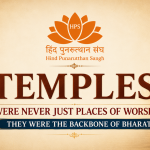
Temples, therefore, are not mere places of worship.
They are the nerve-centres of Hindu civilisation – spiritual, cultural, economic, educational, artistic and social. For thousands of years, the temple was the heartbeat of India.
Yet, the dismantling of temple ecosystems – first by invading rulers and later through colonial and post-colonial policies – fractured Hindu society and severed its civilisational continuity.
This blog brings together the entire story: the ancient glory of temple ecosystems, their destruction, the present challenges, the judicial renaissance of 2025, and a detailed plan to strengthen Hindu unity through temples.
PART 1: TEMPLES AS CIVILIZATIONAL NERVE-CENTRES
Temples Were Not Just Worship Spaces – They Were Multi-System Ecosystems
Historically, temples operated as:
- Spiritual centres
- Educational institutions (pathashalas)
- Healthcare centres (aushadhalayas)
- Economic engines
- Cultural academies
- Social welfare hubs
- Gaushalas (cow shelters)
- Guild-supporting institutions
This model was not theoretical – it existed across India, documented in thousands of inscriptions.
Gaushalas, Aushadhalayas, Pathashalas: How Temples Sustained Society
1. Gaushalas
Maintained through:
- Endowed lands
- Revenue from temple estates
- Community donations
- Local guild participation
They ensured:
- Milk for temple kitchens
- Ghee for rituals
- Charity distribution
- Sustainable agriculture
2. Aushadhalayas (Temple-run Hospitals)
Supported by:
- Temple revenue
- Kings and merchant guilds
- Herbal gardens and pharmacies
They provided free treatment, medicines, surgeries, and Ayurvedic education.
3. Pathashalas (Educational Centres)
Operated through:
- Land endowments
- Donor-funded scholarships
- Community involvement
The curriculum included:
- Vedas and Vedangas
- Arts, crafts, mathematics
- Law, logic, administration
Temples produced scholars, priests, administrators, and technocrats.
Temple Governance: A Scientific, Transparent System
Features included:
- Trustee councils (mahajanas, matha authorities)
- Public accounting on stone inscriptions and copper plates
- Guild and community involvement
- Alignment of festivals with agricultural cycles
In short: temples functioned like autonomous municipal, welfare, and cultural institutions.
PART 2: THE DECLINE – HOW INVASIONS & COLONIALISM DISMANTLED TEMPLE ECOSYSTEMS
Mughal & Sultanate Period
- Temple endowments were seized
- Idols looted
- Gold and wealth transported across territories
- Educational and welfare institutions collapsed
British Era
Colonial policies hit temples harder:
- Land revenue systems (Ryotwari, Zamindari) removed temple ownership
- Temple wealth diverted to municipalities and the colonial state
- Missionary and colonial schools replaced gurukulas
- Bureaucratic interference became the new norm
This was not reform – it was systematic civilisational deconstruction.
PART 3: PRESENT POWER OF THE TEMPLE ECONOMY
Despite centuries of plunder, temples today still hold staggering wealth:
- Total temples in India: 6,49,000
- Tamil Nadu: 69,000
- Karnataka: 35,000
Temple Lands
4 states alone contain nearly 10 lakh acres of temple land:
- TN – 5,00,000 acres
- AP – 4,60,000 acres
- Telangana – 87,000 acres
- Odisha – 13,000 acres
Financial Strength
- Top 10 temples: ₹3-4 lakh crore net worth
- Annual income of top temples: ₹1400+ crore
- Total temple economy: ₹6-7 lakh crore
Examples
- Tirumala: ~10,300 tons of gold
- Padmanabhaswamy Temple: estimated $1 trillion+
This is not just wealth – it is civilisational capital.
And it legally belongs to the Deity, not the state.
PART 4: TEMPLE-BASED NATIONAL UNITY & YOUTH ENGAGEMENT
Temples must become community hubs once more.
Key Strategies
- Cultural preservation: Sanskrit classes, classical arts
- Economic empowerment: Transparent management, micro-grants
- Service activities: Health camps, blood donation, community meals
- Youth engagement: Self-defence workshops, internships, leadership training
- Urban–rural temple partnerships
- Interfaith harmony grounded in confidence, not appeasement
PART 5: YEAR-LONG NATIONAL ACTION PLAN FOR HINDU UNITY
A complete 12-month calendar includes:
- January: National orientation
- February: Youth leadership bootcamps
- March: Seva month
- April: Culture & education
- May: Temple meals
- June: Interfaith harmony
- July: Ratha Yatras
- August: Education reform
- September: Regional culture expos
- October: Skill development
- November: Advocacy month
- December: National impact showcase
All with strong governance, transparency, accessibility, and legal compliance.
THE CRISIS: HOW TEMPLE DONATIONS ARE BEING DIVERTED
A hard truth:
Only Hindu temples are controlled by the government.
Churches manage their own wealth.
Mosques manage their own waqf properties.
But Hindu temples are administered by HR&CE-style state departments.
This leads to:
- Diversion of temple funds
- Missing acres (40,000+ acres in TN)
- Underpaid priests
- Neglected temples
- Political interference in rituals
- Loss of autonomy
Hindus donate with tears, devotion, faith – and much of that money is redirected away from Dharma.
This is not secularism.
This is institutional discrimination.
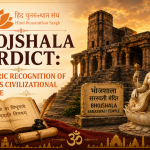
JUDICIAL RENAISSANCE OF 2025
Two landmark judgments restored hope:
1. Madurai Bench – 4 December 2025
Ordered that the Karthigai Deepam must be lit at Tiruparankundram the same evening, protecting devotees’ ancient rights.
2. Supreme Court – 5 December 2025
CJI Surya Kant declared:
“Temple money belongs to the Deity and must be saved, protected and utilised only for the interests of the temple.”
These verdicts are a turning point for Hindu civilisational rights.
CALL FOR ACTION: WHAT HINDUS MUST DO
1. Build a National Temple Autonomy Maha Sangh
A federation of temples, mutts, legal scholars, and devotees.
2. “One Nation – One Law for Religious Institutions” Campaign
Demand equal treatment for temples, churches, mosques, gurdwaras.
3. Use 2025 Judgments as a Legal Weapon
Distribute them nationwide, display them in every temple.
4. Transform Temples into Hindu Unity Hubs
5. Create a Hindu Auxiliary System
Legal, media, youth, and philanthropy wings.
6. Constitutional Electoral Strategy
Support only candidates who commit to temple autonomy.
7. Litigation War Room
50 PILs in 2026 defending temple rights and land recovery.
8. Mass Contact Program: “Ghar Ghar Mandir Charcha”
9. National Temple Rights Yatra
10. A statewide “Deepam Jalao – Nyay Mangao” Movement
Especially in Tamil Nadu.
CONCLUSION: TEMPLES ARE THE PILLARS OF HINDU UNITY
Temples are not just structures – they are living civilisational ecosystems.
They unify Hindus across castes, regions, languages, and traditions.
The judiciary has given Hindus the strongest civilisational foundation in decades.
Now the responsibility lies with society:
- To awaken
- To unite
- To act
- To reclaim what is ours
- To restore temple autonomy
- To rebuild Hindu civilisation with confidence
Temples represent Sanatana Dharma.
Temple rights represent Hindu rights.
Protecting them is protecting our civilisation.
Jai Shri Ram
Har Har Mahadev
Bharat Mata ki Jay
Vande Mataram
By: Shri Ramanatha Iyer