

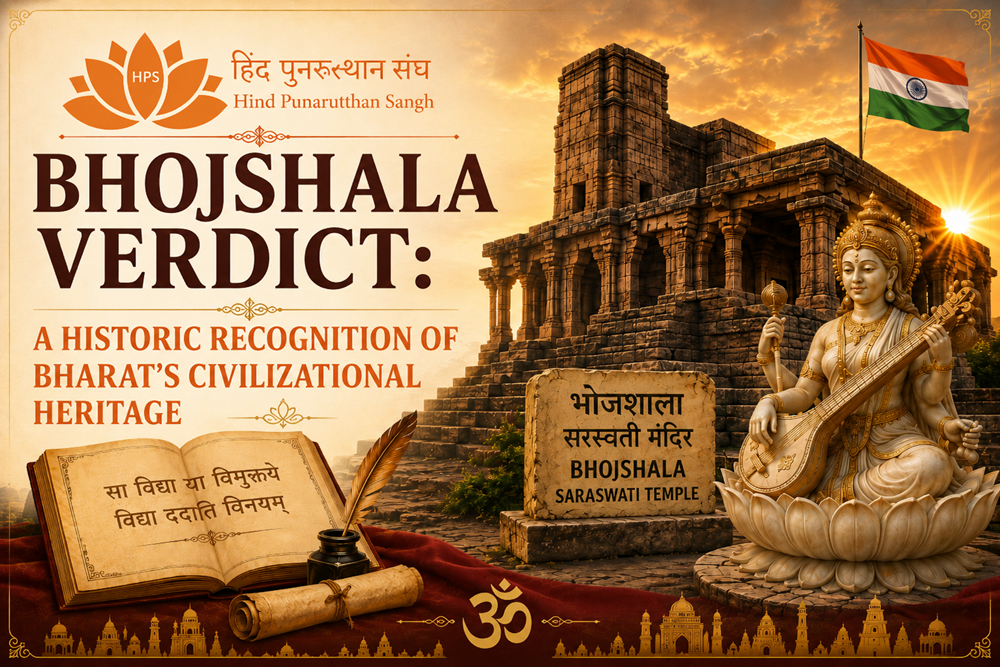
In a landmark judgment that carries deep cultural, historical, and spiritual significance, the Madhya Pradesh High Court has declared the disputed Bhojshala Temple-Kamal Maula Mosque Complex in Dhar as a temple dedicated to Goddess Saraswati. The verdict marks a major moment in the ongoing effort to restore and preserve Bharat’s ancient civilizational identity.
The court’s observations not only reaffirm the historical roots of Bhojshala as a sacred Hindu site but also recognize the uninterrupted continuity of Hindu worship and learning traditions associated with it.
Bhojshala: A Centre of Sanskrit Learning
The High Court noted that historical literature and records establish Bhojshala as a renowned centre of Sanskrit learning associated with Raja Bhoj of the Parmar dynasty. Raja Bhoj is remembered as one of Bharat’s greatest scholar-kings, whose contributions to education, literature, architecture, and dharmic culture continue to inspire generations.
The bench emphasized that the continuity of Hindu worship at the site “has never been extinguished,” reinforcing the long-standing connection of devotees with Maa Saraswati, revered as the Goddess of wisdom, learning, and knowledge.
The court also underlined the constitutional duty of authorities to ensure:
- Preservation of the sanctity and character of the deity
- Protection of the monument
- Basic amenities for pilgrims and worshippers
Recognition of the Temple’s Religious Character
In a significant observation, the High Court held that the religious character of the disputed structure is that of Bhojshala – the temple of Goddess Vagdevi Saraswati.
This recognition carries immense importance for those who have long maintained that Bhojshala represents not merely an archaeological structure, but a living symbol of Bharat’s spiritual and educational heritage.
Hindu Worship Rights Restored
One of the most notable aspects of the verdict was the quashing of portions of the Archaeological Survey of India’s 2003 order that had restricted Hindu worship within the complex while permitting namaz.
The court clearly stated that the order limiting Hindu worship rights and allowing namaz within the premises cannot stand. This decision is being seen as a restoration of traditional worship practices and historical continuity at the site.
ASI to Continue Preservation and Administration
While affirming the temple’s identity, the High Court also clarified that the Archaeological Survey of India (ASI) will continue to maintain supervisory control over the preservation and conservation of the monument.
The Centre and ASI have been directed to take appropriate decisions regarding:
- Administration and management of Bhojshala
- Preservation of Sanskrit learning activities
- Overall maintenance of the heritage structure
This ensures that both heritage conservation and cultural continuity remain protected.
Hope for the Return of Maa Saraswati’s Idol
In another emotionally significant observation, the court stated that the Centre may consider representations seeking the return of the idol of Goddess Saraswati currently housed in a London museum.
For countless devotees and cultural organizations, the return of Maa Saraswati’s idol would symbolize not merely the restoration of an artifact, but the reclaiming of a sacred legacy connected to Bharat’s spiritual and intellectual traditions.
A Moment of Civilizational Reawakening
The Bhojshala verdict is more than a legal development. It is a reminder of Bharat’s timeless heritage of knowledge, spirituality, and cultural continuity. The recognition of Bhojshala as a Saraswati temple strengthens the ongoing national effort to preserve sacred spaces that have shaped the identity of this civilization for centuries.
As Bharat moves forward, such moments reinforce the importance of protecting historical truth, honoring cultural memory, and ensuring that future generations remain connected to the roots of Sanatan civilization.
भोजशाला निर्णय : भारत की सांस्कृतिक चेतना और सनातन विरासत की ऐतिहासिक विजय
मध्य प्रदेश उच्च न्यायालय द्वारा भोजशाला मंदिर–कमाल मौला मस्जिद परिसर को माँ सरस्वती का मंदिर घोषित किया जाना भारतीय संस्कृति, इतिहास और सनातन परंपरा के लिए एक अत्यंत महत्वपूर्ण एवं ऐतिहासिक निर्णय है। यह फैसला केवल एक कानूनी निर्णय नहीं, बल्कि भारत की प्राचीन सभ्यता, ज्ञान परंपरा और सांस्कृतिक अस्मिता की पुनर्पुष्टि भी है।
न्यायालय ने अपने निर्णय में स्पष्ट रूप से माना कि भोजशाला सदियों से हिन्दू आस्था, पूजा और संस्कृत अध्ययन का केंद्र रही है तथा यहाँ हिन्दू उपासना की परंपरा कभी समाप्त नहीं हुई।
राजा भोज की ज्ञानभूमि
उच्च न्यायालय ने ऐतिहासिक साहित्य और अभिलेखों के आधार पर यह माना कि भोजशाला परमार वंश के महान राजा भोज से जुड़ा संस्कृत अध्ययन का प्रमुख केंद्र था। राजा भोज भारतीय इतिहास के उन महान शासकों में गिने जाते हैं जिन्होंने शिक्षा, साहित्य, वास्तुकला और धर्म-संस्कृति को नई ऊँचाइयाँ प्रदान कीं।
न्यायालय ने कहा कि इस स्थल पर हिन्दू पूजा की निरंतरता कभी समाप्त नहीं हुई। यह टिप्पणी इस बात को प्रमाणित करती है कि भोजशाला केवल एक पुरातात्विक संरचना नहीं, बल्कि माँ वाग्देवी सरस्वती की जीवंत आराधना का केंद्र रही है।
साथ ही न्यायालय ने यह भी कहा कि:
- तीर्थयात्रियों को मूलभूत सुविधाएँ उपलब्ध कराना राज्य का दायित्व है।
- मंदिर की पवित्रता और देवी के स्वरूप का संरक्षण आवश्यक है।
- ऐतिहासिक एवं धार्मिक चरित्र को सुरक्षित रखा जाना चाहिए।
भोजशाला का धार्मिक स्वरूप : माँ वाग्देवी सरस्वती का मंदिर
न्यायालय ने अपने निर्णय में स्पष्ट कहा कि विवादित परिसर का धार्मिक स्वरूप भोजशाला अर्थात माँ वाग्देवी सरस्वती के मंदिर का है।
यह टिप्पणी उन करोड़ों हिन्दुओं की भावनाओं को सम्मान देती है जो वर्षों से भोजशाला को भारत की ज्ञान, संस्कृति और आध्यात्मिक परंपरा का प्रतीक मानते आए हैं।
हिन्दू पूजा अधिकारों की पुनर्स्थापना
इस निर्णय का सबसे महत्वपूर्ण भाग वह रहा जिसमें न्यायालय ने भारतीय पुरातत्व सर्वेक्षण (ASI) के वर्ष 2003 के उस आदेश के कुछ हिस्सों को निरस्त कर दिया, जिसमें हिन्दुओं के पूजा अधिकारों को सीमित किया गया था जबकि परिसर में नमाज़ की अनुमति दी गई थी।
न्यायालय ने स्पष्ट कहा कि हिन्दुओं के पूजा अधिकारों पर प्रतिबंध लगाने और नमाज़ की अनुमति देने वाला आदेश टिक नहीं सकता।
यह निर्णय हिन्दू समाज की उस ऐतिहासिक आस्था और परंपरा की पुनर्स्थापना माना जा रहा है जो सदियों से भोजशाला से जुड़ी रही है।
ASI करेगा संरक्षण और प्रबंधन
उच्च न्यायालय ने यह भी स्पष्ट किया कि भारतीय पुरातत्व सर्वेक्षण (ASI) स्मारक के संरक्षण और रखरखाव की जिम्मेदारी निभाता रहेगा।
केंद्र सरकार और ASI को निर्देश दिए गए हैं कि वे:
- भोजशाला मंदिर के प्रशासन एवं प्रबंधन
- संस्कृत अध्ययन गतिविधियों
- स्मारक के संरक्षण
के संबंध में उचित निर्णय लें।
इससे यह सुनिश्चित होगा कि सांस्कृतिक विरासत और ऐतिहासिक धरोहर दोनों सुरक्षित रहें।
माँ सरस्वती की प्रतिमा वापसी की उम्मीद
न्यायालय ने लंदन संग्रहालय में रखी माँ सरस्वती की प्रतिमा को वापस भारत लाने की मांग पर भी महत्वपूर्ण टिप्पणी की। अदालत ने कहा कि केंद्र सरकार इस संबंध में दिए गए प्रतिवेदनों पर विचार कर सकती है।
यह केवल एक प्रतिमा की वापसी नहीं होगी, बल्कि भारत की सांस्कृतिक चेतना, ज्ञान परंपरा और आध्यात्मिक गौरव की पुनर्स्थापना का प्रतीक होगी।
सांस्कृतिक पुनर्जागरण का प्रतीक
भोजशाला पर आया यह निर्णय भारत की सनातन परंपरा, सांस्कृतिक स्मृति और राष्ट्रीय चेतना के पुनर्जागरण का प्रतीक है। यह फैसला आने वाली पीढ़ियों को अपनी जड़ों, अपनी परंपराओं और अपनी सभ्यता से जोड़ने की दिशा में एक महत्वपूर्ण कदम है।
भारत की पहचान केवल भौगोलिक सीमाओं से नहीं, बल्कि उसकी हजारों वर्षों पुरानी ज्ञान, धर्म और संस्कृति की परंपरा से है। भोजशाला निर्णय उसी गौरवशाली विरासत की पुनर्पुष्टि करता है।